The evolution of a national locomotive
This publication, prepared by Pauline Ascon, follows our previous post on the “Evaluation of socio-political contexts” and provides a summary of Chapter 3 of Florian Auclair’s thesis, highlighting how the dual-grid framework was applied to understand the social acceptability of a BECCS project in England.
BECCS in England
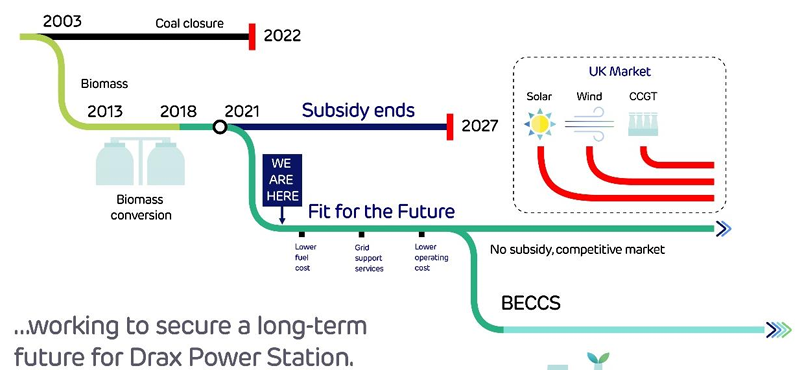
In this chapter, Florian Auclair applies the methodological framework established in the previous section to the Drax Power Station, a site that has evolved from a 1960s coal giant into a controversial testing ground for BECCS.
First, Florian focuses on applying its contextual grid : by tracing the station's 60-year history, the author identifies four distinct contextual phases that explain its survival and its shift toward BECCS. Then, on the most recent period of history of the Drax Power station, he applied his Acceptability grid.
The Contextual Evolution of Drax (1964–2027)
The first period, from 1964 to 1990, is marked by the construction of the power station and the installation of sulphur filters to lower pollutants emissions. Built near high-yield coal mines, Drax was a state-led project executed by the public producer (CEGB). During this time, coal represented national sovereignty and growth. The plant remained largely immune to international environmental treaties, with the government directly financing pilot operations like sulphur filters to maintain its "coal is king" status.
The second period, from 1990 to 2005, is marked by “banalization” and a succession of different owners. With the privatization of the energy sector, the plant's representation shifted from a strategic asset to a banal financial one. Ownership passed through various non-specialist foreign investors. While the government stepped back to let the market lead, it began enforcing decarbonization targets through European regulatory constraints.
The third period, from 2005 to 2015, is marked by Carbon Capture and Storage. Following its entry on London Stock Exchange, Drax attempted a small-scale CCS pilot project. Though the G8 and the UK government promoted "Capture Ready" status and financial support, the political style was based on the "state proposes, industry implements" logic. This lack of direct state execution led to the project's eventual cancellation in 2015.
The last period, from 2012 to 2027, is marked by a shift from carbon to biomass. Faced with imminent closure, Drax converted four of its six boilers to burn wood pellets. This period is defined by vertical integration, where Drax acquired its own forest suppliers to secure fuel. The operation is entirely dependent on Renewable Obligation Certificates (ROCs) which are a public subsidy instrument that compensates for the plant's structural lack of profitability.
The Acceptability Framework Applied to BECCS
Using the "consequential" grid, Florian reveals that controversies surrounding Drax span the entire BECCS value chain, from ethical principles to local safety:
On its analysis of the Pole of Principles, Florian could establish that, for the Drax power station, critics challenge the carbon neutrality of biomass, citing the slow regrowth of forests and ignored biodiversity loss. Furthermore, the ethical injustice of pellet production is raised, as marginalized communities near supply sites suffer from air pollution without seeing the benefits.
Then, the analysis of the Inter-Poles Acceptability showed that Drax's survival depends on nearly £800 million in annual subsidies, sparking debate over whether taxpayer money should support a structural deficit project. Suspicions of favouritism of Drax by the UK government further undermine the legitimacy of these public policies.
Finally, Florian’s findings about the Local Pole were the following. Downstream, the lack of clear safety standards for CO2 pipelines remains a potential dealbreaker for residents. Additionally, "usage conflicts" are emerging offshore, where carbon storage sites compete for space with wind farm projects, complicating the administration's licensing process.
In the following chapter, Florian analyses the historical and acceptability contexts in relation to BECCS in a different setting: the KVV8 station in Sweden. This second case study completes the data needed for the comparison of social acceptability contexts.