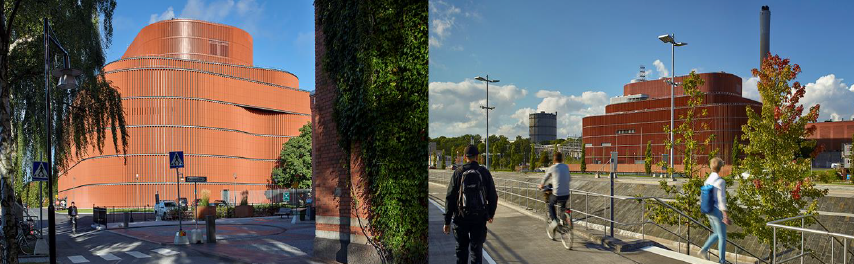
Two views of the KVV8 power plant from adjacent streets (photos: Mikael Olsson & Robin Hayes)
A Favorable Context for BECCS? The Case of KVV8 in Sweden
This publication, prepared by Pauline Ascon, follows our previous post on the UK case and provides a summary of Chapter 4 of Florian Auclair’s thesis, focusing on the KVV8 case study in Sweden and its role in understanding BECCS social acceptability in a contrasting national context.
National and Local Context: The Swedish Model
Unlike the centralized British approach, the Swedish context is defined by a strong decentralization of energy decisions and a long history of bioenergy.
On the National Level, Florian identifies a material imbalance between the upstream and downstream of the value chain. While Sweden lacks immediate CO2 storage sites and faces diplomatic complexities in the Baltic Sea, it possesses a "luxuriant" upstream ecosystem. With a forestry-heavy economy and pioneer policies like the 1991 carbon tax, the national materiality and stakeholder configuration are perfectly aligned to support biomass.
On the Local Level, Stockholm enjoys significant autonomy in its energy production. The political style here is collaborative, with the city co-owning the operator, Stockholm Exergi. For the city, BECCS is a tool for international prestige, an ecological strategy to showcase global leadership in decarbonization.
Acceptability Study: Hesitants developers and silent oppositions
The study of social acceptability regarding the KVV8 power station reveals a paradox: developers are fearful, yet opponents remain largely discreet.
In contrast to the UK, the supply of wood for energy is culturally and economically integrated in Sweden, sparking very little local debate.
Despite low current opposition, developers are still structured by a fear of the "NIMBY" effect. They focus their communication on technical and economic local benefits to convince neighbors, often missing the broader legitimacy issues of the industry.
Real resistance is not local but rather based on the principle of BECCS technology. Like the findings in England, NGOs at national and European levels question the actual capacity of BECCS to produce "negative emissions." While these actors are quiet now, they represent a high risk for legal challenges once building permits are filed.
The Swedish case demonstrates a successful alignment of political levels (local and national) that provides a stable foundation for the upstream chain of BECCS, something the UK struggles with. However, Florian concludes that even a perfectly developed technical chain cannot escape global controversies. The political project behind BECCS still needs to be redefined; without a clear consensus on its environmental legitimacy, even the most integrated projects remain fragile.
In the following chapter, Florian compares the deployment of BECCS in England and Sweden and how these 2 case studies are complementary to understanding the greater context of social acceptability of the innovation.