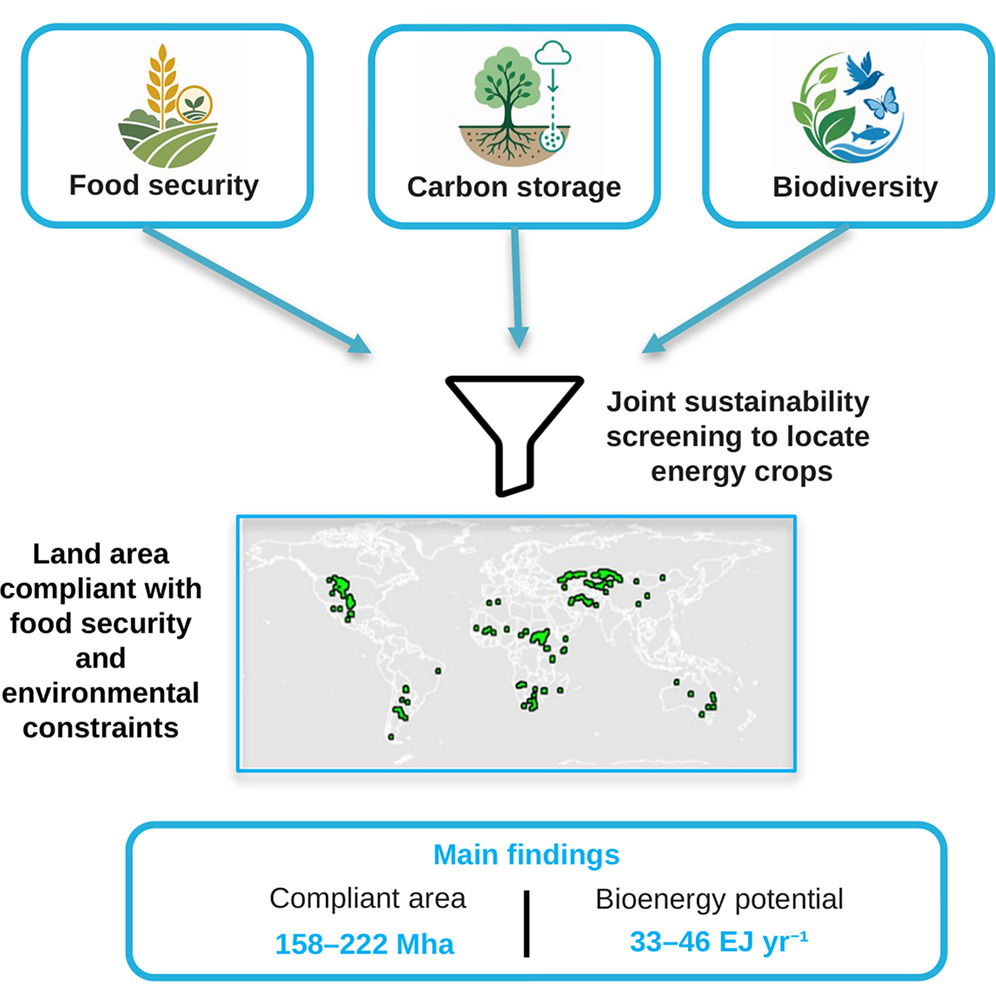
The last publication from Siwar Saadaoui “Joint compliance with food security and environmental constraints limits the global potential of energy crops” (Saadaoui, Brunelle, & Gabrielle, 2026) assesses how much bioenergy can realistically be produced from dedicated energy crops when both food security and environmental protection are considered simultaneously.
Key findings
- Many previous studies estimated relatively large areas available for energy crops but did not fully account for impacts on food production, biodiversity, and ecosystem carbon storage.
- The authors developed a high‑resolution global assessment that combines:
- land opportunity costs (using land prices as a proxy for competition with food production),
- biodiversity protection,
- ecosystem carbon conservation.
- When these constraints are applied together, the amount of land considered suitable for energy crops falls substantially. At their central scenario (30% compliance threshold), only 158–222 million hectares are suitable globally, yielding about 33–46 EJ/year of bioenergy.
- Suitable low-conflict areas are concentrated in parts of Sub‑Saharan Africa, Kazakhstan, the western United States, and Australia.
Main message
The study concludes that the sustainable global potential of energy crops is considerably lower than many earlier estimates. Bioenergy can still contribute to climate mitigation, but its role is likely more limited once food security and environmental safeguards are properly enforced. Policymakers should therefore be cautious about relying on very large-scale bioenergy deployment in future energy-transition scenarios.
One-sentence takeaway:
The paper shows that after accounting for food production needs, biodiversity protection, and carbon-rich ecosystems, the global land and energy potential for bioenergy crops is much more constrained than commonly assumed.
You can find more information about Siwar Publication here.