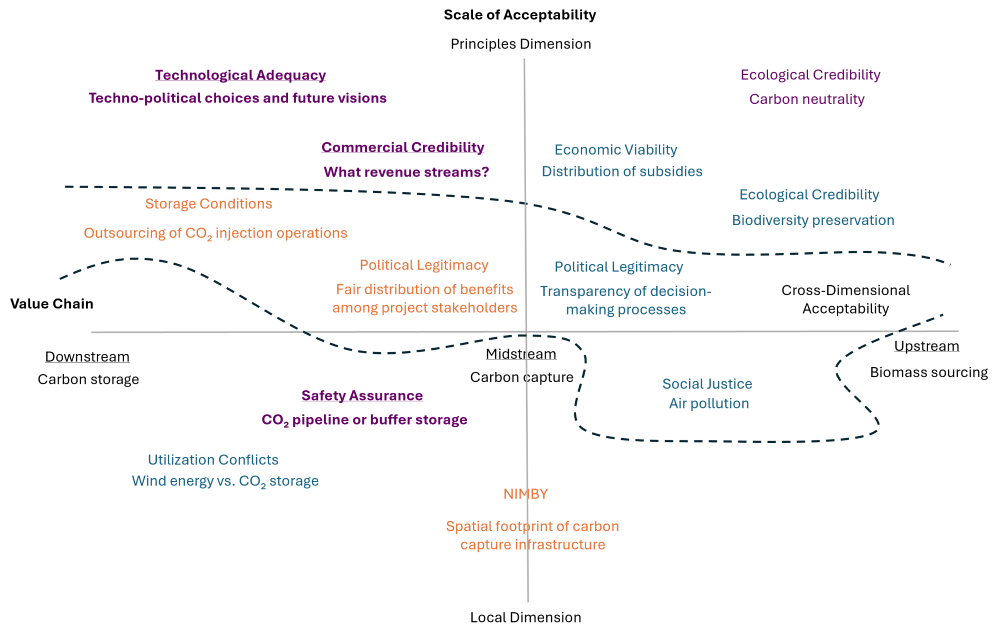
Figure: Social Acceptability issues positioned on the acceptability scale and the BECCS value chain (purple - issues common to both projects, orange - issues specific to Sweden, blue - issues specific to the United Kingdom)
What Shapes the Social Acceptability of BECCS?
This publication, prepared by Pauline Ascon, follows our previous post on the Sweden case and provides a summary of Chapter 5 of Florian Auclair’s thesis, which focuses on comparing the development of BECCS in Sweden and United Kingdom.
Path Dependency: How the Past Shapes the Present
Florian demonstrates that current BECCS trajectories are "path dependent," rooted in decades of historical techno-political choices. While both projects are retrofitted onto existing plants, their materiality and actor configurations differ sharply: Drax is a private, rural, coal-legacy giant ten times the size of KVV8, whereas KVV8 is a municipal joint venture integrated into Stockholm’s urban heating grid.
Politically, the UK’s centralized, liberal, and often unstable bipartisanship contrasts with Sweden’s consensus-based, social-democratic culture, where municipalities hold significant power. These backgrounds lead to different Collective Representations: the UK pursues global economic growth and industrial leadership, while Sweden prioritizes regional ecological exemplarity.
Mapping Acceptabilities: Universal vs. Contextual
By mapping 12 distinct acceptability issues, Florian separates "technology-specific" challenges from "context-specific" ones. Issues appearing in both cases are attributed to the technology itself, while unique challenges reveal the influence of local history.
- The UK (Drax): Faces 5 specific challenges, largely centered on the "upstream" biomass supply (ethics and carbon neutrality).

Figure 1: Social Acceptability issues positioned on the acceptability scale and the BECCS value chain (purple - issues common to both projects, orange - issues specific to Sweden, blue - issues specific to the United Kingdom)
Causal Links: Context as a Driver of Acceptance
Florian identifies a clear inverse relationship based on national history. The UK’s oil and gas heritage facilitates the acceptance of CO2 storage (downstream) but complicates biomass management (upstream). Conversely, Sweden’s forestry culture ensures "upstream" mastery but leaves the country uncertain about the logistics of offshore storage. Currently, due to low technological maturity, debates remain focused on global ethics rather than local nuisances.
A Inherently Controversial Technology
BECCS is controversial regardless of context. Four universal "technology-specific" pillars undermine its legitimacy: Local Safety: Lack of proven safety standards for large-scale CO2 transport near populated areas; Transition Legitimacy: Fears that BECCS serves as a "business as usual" excuse to avoid real sobriety; Commercial Credibility: The absence of a market for negative emissions makes the technology entirely dependent on uncertain future regulations and; Carbon Accounting: Doubts regarding the theoretical neutrality of biomass and its impact on land use and indigenous rights (e.g., the Sami people in Sweden).
Ultimately, while context shapes where the friction occurs, the fundamental legitimacy of BECCS remains a global political challenge yet to be resolved.
You can find more details about Florian's work here.